



Introduction
The Harlem-based manufacturing companies are standing at a critical juncturein their development. While they are working towards improving the quality and preparing to emerge into a bigger world, they come across major challenges that have their roots in the conventional methodsof machine operations. These old methods have often resulted in poor accuracy of the parts being produced and difficulties associated with maintaining a smooth quality control process for the products or parts being manufactured. In a recent study conducted by the American Society of Mechanical Engineers (ASME), it was found that a whopping 60% of quality variation problems being faced by manufacturing companies have originated from the absence of a systematic process control system.
This piece would gradually highlight the most recent development associated with the use of precision turning in CNC to provide a viable technological solution to the companies at hand.
How Does CNC Precision Turning Enable Machining at the Micron Level?
Essentially, precision turning is a technology far beyond mere size reduction to a defined size; it is a comprehensive system possessing a level of precision in control that encompasses advanced technology and the careful validation of this control. Precision turning is excellent in the control of the three essential dimensions: size accuracy, geometric precision, and surface quality. Precision studies carried out by the American Society of Precision Engineering, or ASPE, show that a closed-loop control system in modern CNC machines allows a positioning accuracy of ±0.002mm.
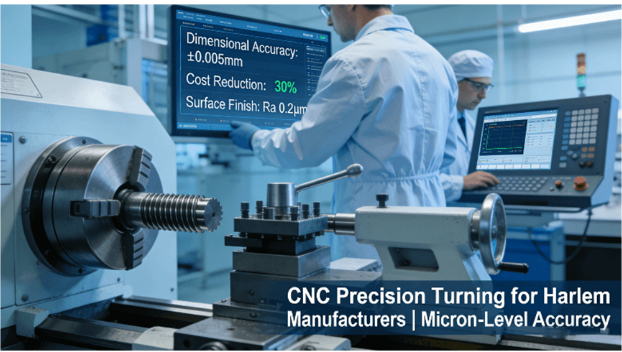
To ensure a dimensional accuracy of ±0.005mm, it requires a complete system approach. Not only should there be a stable machine tool, but it should also be implemented in a temperature-controlled production environmentalong with online correction for tool wear. Moreover, geometric tolerances, such as roundness, a value of which should not exceed 0.003mm, play an important role for dynamic models, such as bearing rings, as it reduces oscillations during a higher speed. Meanwhile, a premium surface integrity with Ra ranging between 0.2 to 0.4μm is obtained through premium tools, namely CBN-inserts, and constant surface speed turning, which is also important to ensure lower friction coefficients, as well as higher fatigue resistance to dynamic parts. For more information on technical details, kindly consult this complete CNC precision turning guide.
Application of Precision Turning Technology in the Manufacture of Medical Devices
The healthcare sector is one of the industries that follows the most demanding specificationsin component production. This is due to the fact that medical components, especially implants and surgery instruments, require an unparalled standard of accuracy, compatibility, and surface finish. The U.S. Food and Drug Administration usually specifies a tolerance limit of ±0.01mmin the case of medical implants.
1. Key Technical Considerations for Medical Applications
l Biocompatible Materials: Materials such as Ti-6Al-4V ELI (Extra Low Interstitial) titanium alloy are preferred due to their high strength, low weight, and high degree of biocompatibility. Machining these materials also demands some parameters for work hardening.
l Aseptic Surface Finishes: The surfaces have to be very smooth, with a Ra of less than 0.2 micron, to ensure that there are no bacteria and to make it easier to clean and sterilize.
l Full Traceability: Each process, ranging from raw material certification to the final inspection, needs to be documented to the fullest extent to satisfy the requirement of ISO 13485 for complete traceability of all the components.
H3: 2. Process Solutions for Complex Medical Parts
- Bone Screws and Implants: These components have very tight tolerances with micron-level thread specificationsand require excellent surface finishes. CNC turning machines with live tooling are capable of turning intricate threads and details directly in a single operation for perfect alignment and consistency.
- Surgical Instrument Shafts: Typically a thin-walled, elongated design, these parts are highly susceptible to bending. Care must be exercised in supporting and cutting the parts to maintain a straightness requirement.
- Housings and Connectors: Although these may be machined by a combination of turns and milling operations, mill-turn machines are the best-suited ones because they can perform complete processingwithout re-clamping.
Quality and Certification Imperatives
Providers to healthcare must have relevant certifications, such as ISO 13485, which stipulates that it has to have a strong quality management system. This implies that it has to satisfy manufacturing parts in quantities of either prototyping or 10,000 with exactly the same stringent standards.
What Key Links Are Included in the Precision Turning Quality Control System?
“A sound quality control system is the key to trustful precision manufacturing. This is a data-based approach which ensures consistency in the manufacture of both large-scale and small-scale series, right from the raw material stage through the completed product. Expert CNC turning service suppliers invest in quality management systems like ISO 9001 or ISO 13485, which enables them to ensure the complete traceabilityof the whole procedure.”
1. In-Process Control and Monitoring
Statistical Process Control (SPC)is important to employ. By tracking important features online during the manufacturing process, problems can be anticipated and adjusted before the components go out of spec. Probes on the machine provide the capability to take the measurement of components within the process and compensate accordingly for tool wear or temperature variation.
Figure 2: CNC precision turning eliminates cumulative errors through real-time monitoring, achieving 60% higher accuracy and reducing scrap rates by 25% compared to conventional methods for Harlem manufacturers.
2. Final Inspection and Verification
Before any product is delivered, a final inspection has to be conducted, and the part has to be checked by the use of sophisticated technology such as the Coordinate Measuring Machines (CMM). The inspection procedure entails the use of surface roughness testers to make sure that the values of the Ra, Rz parameters of the finished products are accurate. The test proves that all Documentation and Traceability
Every order is provided with a comprehensive quality record starting from material certifications, inspection results, and processing data. This gives a complete traceability, especially required in aerospace and medical fields. In the event of a detected non-conformance, the root cause is easily identifiable. If a supplier exhibits a quality system, it is advisable to investigate the possibilities of expertise provided by a professional CNC turning service.
In what way can the Precision Turning Process be optimized to achieve Cost-Effectiveness?
Cost Optimizationin Precision Turning: Cost optimization in precision turning entails more than finding the lowest possible unit cost; it also entails lowering the overall cost of operation by innovation in technology as well as optimal process planning. Research by the National Association of Manufacturers indicates that by optimizing processes, companies can save an average of 15-20%in manufacturing cost.
1. Design For Manufacturability Analysis
Design for manufacturability analysisperformed proactively can be among the best methods for cost control at the design stage. Specialists can propose variations in non-critical tolerances or a slight change in geometries for improved machinability and even cut machining time and cost of tools by over 20%.
2. Process Routing Optimization & Tooling
l Consolidated Machining Operations: By using mill turn machines, the combined machining operation such as turning, milling, and drilling can be accomplished in one operation. The result will be drastic reductions in handling time and total production cycle time.
l Intelligent Tooling Strategies: Employing the appropriate substrate and form of the tool in relation to the materials can lead to increased tool lifeand faster cutting speeds.
l Adaptive Machining Parameters: Today’s CNC machines are equipped with the ability to vary the feeds and speeds as per the real-time force of cutting for optimizing machining processes with regard to both effectiveness and tool life.
3. Material Selection and Production Planning
In some cases, when it comes to applications involving businesses in Harlem, it is important to determine the best material that suits the working conditions. For example, if material is machinable and if a good surface finish is obtained, it could actually turn out to be a cheaper substitutewhen compared to a high-quality material. Additionally, running similar components may help optimize machine setup time.
What are the Technological Challenges of Modern Precision Turning, and How Are They Resolved?
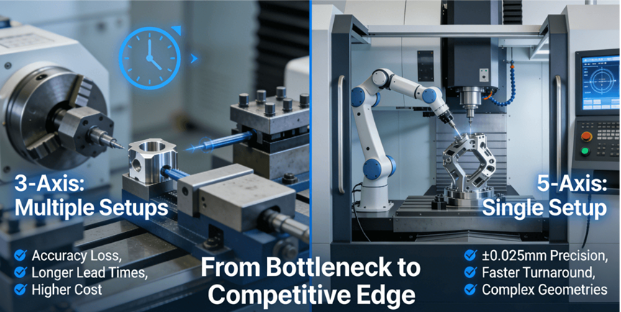
Precision turning, despite its advanced technological capabilities, still finds itself faced with some challenges, especially when dealing with difficult-to-cut materialsand intricate designs. According to the International Federation of Robotics, incorporating robotic automation systems can improve efficiency by over 30%.
1. Machining Difficult
Materials such as Inconel or heat-treated steels are difficult to machine as they cause rapid tool wear and work hardening. These can be overcome using specialized tool coating materials such as AlTiN, the usage of high-pressure coolant systems, or the implementation of trochoidal turning.
2. Complex and Thin-Walled Structures
The possibility of vibrations is high in case of complex parts that have thin walls. The best way to avoid this is to opt for machines that have multiple axeswith CNC technology, which gives it a better grip. One also needs to adjust the cutting parameters to cut at higher depths to avoid vibrations. Simulation tools will help in identifying possible chatter in the cutting operation.
3. Maintaining Stability at High Volume Production
This would necessitate a systems approach to maintain micron-level accuracyover long production volumes. This would include environmental controls (e.g., temperature controls), a high-quality tool life prediction system (to predict tool changes before their failure), and a closed-loop quality control system providing feedback to the machine for automatic correction.
Conclusion
CNC turning services plays a crucial role in providing a strong technological base for the manufacturing units of the Harlem region by systematically improving the accuracy of the manufacturing process. As a result of implementing the modern techniques, the companies are able to reduce the cost of machining and improve the position in the market.
FAQs
Q1: Which workpieces are suitable for precision turning?
A1:The technology has the capability to work with a large variety of metals, such as stainless steel, titanium alloys, aluminum, and so on. The challenge lies in adjusting the parameters depending on the type of material, for example, in the case of titanium where lower cutting speedsand other specific materials are required for the tools.
Q2: What is involved in ensuring dimensional stability in mass-produced products?
A2:Stability is achieved through controlled machining environments,-automatic compensation for tool wear, and real-time monitoring. It is recommended to conduct intermediate inspection for every 50 pieces.
Q3: How are problems of Machining difficulty/complexity, structural complexity solved, particularly
A3:The solutions entail the use of multi-axis linkage technology, special fixtures, and cutting strategies. For a thin-walled structure, a cutting strategy that employs a small depth of cut and a high cutting speed is employed.
Q4: What is a typical level of surface roughness?
A4:With optimized processing parameters, the value of surface roughness Ra = 0.2 to 0.4 μmcan be achieved. Using diamond cuts and appropriate coolant, even the mirror finish below Ra 0.1 μm can be obtained.
Q5: What technical data is required in the development of new products?
A5:Completed product drawings or 3D models must be provided along with callouts for critical dimension tolerancing and material specifications. Performing a DFM Analysisbefore designing would be highly beneficial in terms of manufactureability.
Author Bio
The author has extensive experience in the manufacturing industry, and his team, LS Manufacturing, is highly skilled in precision turning technology and holds international certifications such as ISO9001 and IATF 16949, which ensures their quality assurance when completing complex manufacturing tasks.